
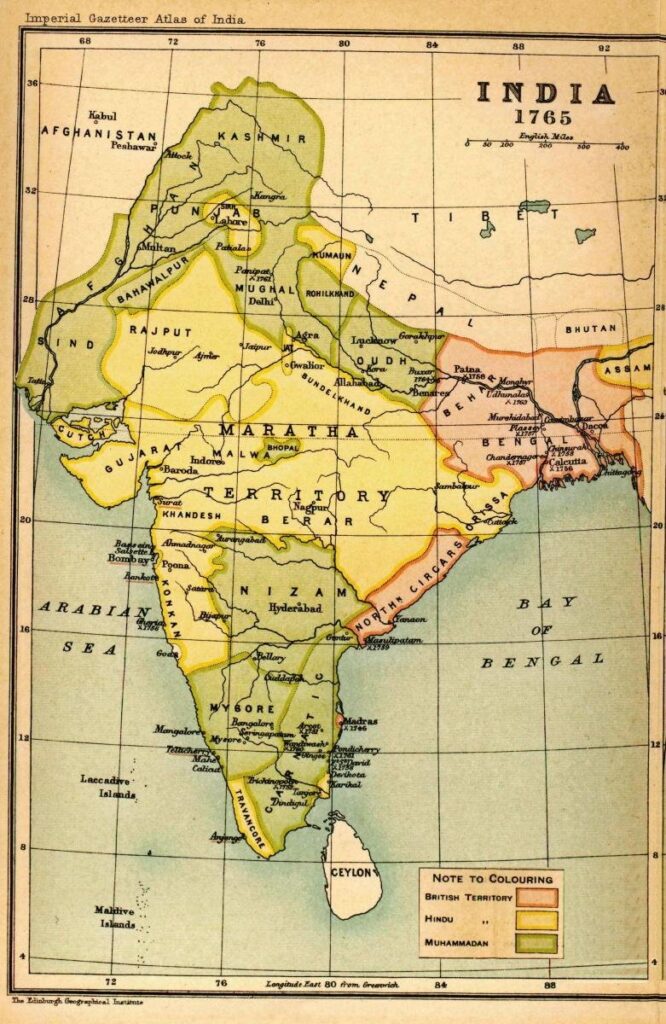
Robert Clive used Bengal as a kind of springboard to gain control of all of India. The map also shows what parts of the country were Muslim and which were Hindu. There was a violent separation of the two when Pakistan was formed in 1947.
Origins of the Company
Originally founded in 1600, the British East India Company (EIC) attained dominance over much of India after the Battle of Plassey in 1757. The Mughul Empire—it was in a period of decline–controlled much of the interior of the country. The East India Company captured and fortified the coastal cities of Calcutta, Bombay, and Madras. (History: “How the British East India Company Became the World’s Most Powerful Monopoly” by Dave Roos, May 28, 2025)
The Seminal Battle of Plassey
At the Battle of Plassey Libra Robert Clive achieved victory over a vastly superior force by bribing the opposing force’s demoted chief-of-staff, Kir Jafir, and several others. Also, a heavy rainstorm occurred during the battle. The British protected their gunpowder by putting tarpaulins over it. His opponents failed to do so. (Wikipedia, “The Battle of Plassey”)
How Clive’s Financial Machinations Enabled Him to Wrest Control of the Subcontinent
The Treaty of Allahabad in 1765 granted the EIC the right to control the finances of Bengal. Clive was appointed governor and took over tax collection. The Company used the taxes it collected from the people of Bengal to finance its expansion over the rest of India. The EIC became a colonial power. (History: “20 Facts About the East India Company” by Adam Dalrymple, September 26, 2019)
The EIC’s Pernicious Opium Trade
The EIC began growing opium in India and selling it to Chinese merchants in the 1770s in exchange for porcelain and tea. This caused much addiction. The Qing Dynasty outlawed the trade; nevertheless, it continued surreptitiously. The Qing destroyed tens of thousands of chests of opium in China. This led to the Opium War of 1839. The British navy attacked the Chinese coast. The Treaty of Nanjing in 1842 gave British merchants the right to sell opium, and the Chinese were forced to cede the port of Hong Kong. (Roos and Wikipedia) Millions wasted their lives away in opium dens.
In 1857 the Indians rebelled against the EIC. About 800,000 Indians and 6,000 British died. The British savagely repressed the mutineers.
The EIC was dissolved in the 1870s. English politicians and businessmen found they could make more money without it. (Dalrymple)
Robert Clive (1725-1774) and His Horoscope
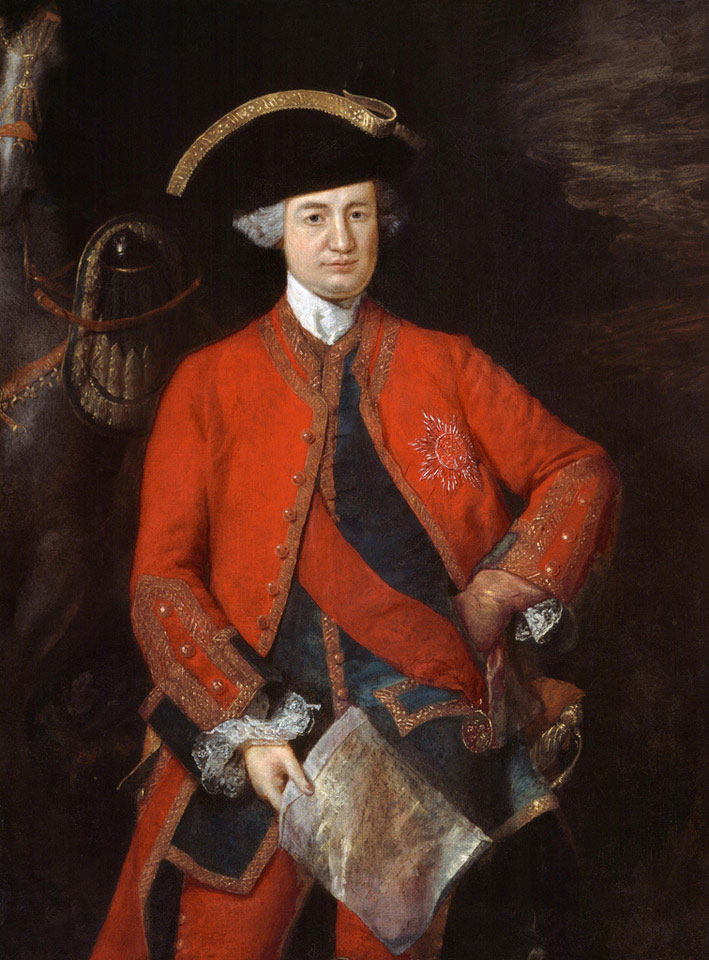
Robert Clive began his career as a clerk for the EIC in Madras. He became an ensign in the company’s private army in 1747; thereafter, his rise to Major General was steady.
Clive was twice Governor of Bengal (1758-1760, 1764-1767). His first administration was noted for the plundering of the province. It was during his second administration that he created a huge civilian and military administration to collect taxes.
Baron Clive returned to England to defend himself on corruption charges. He said in typical Libra fashion, “I’m astonished at my own moderation.” Parliament passed a resolution in his favor. Robert passed away in 1774 with a net worth of 500,000 pounds or about $33 million today. (National Army Museum: “Robert Clive: The Nabob General”) [All material for Clive’s biography was obtained here.]
Using Marc Edmund Jones’ typology, Robert Clive’s planetary pattern for his natal chart would probably be the splay. There are sharp and irregular aggregations of planets at irregular points. This suggests “highly individual or purposeful emphases in life.” (Jones, Guide to Horoscope Interpretation, p. 104)
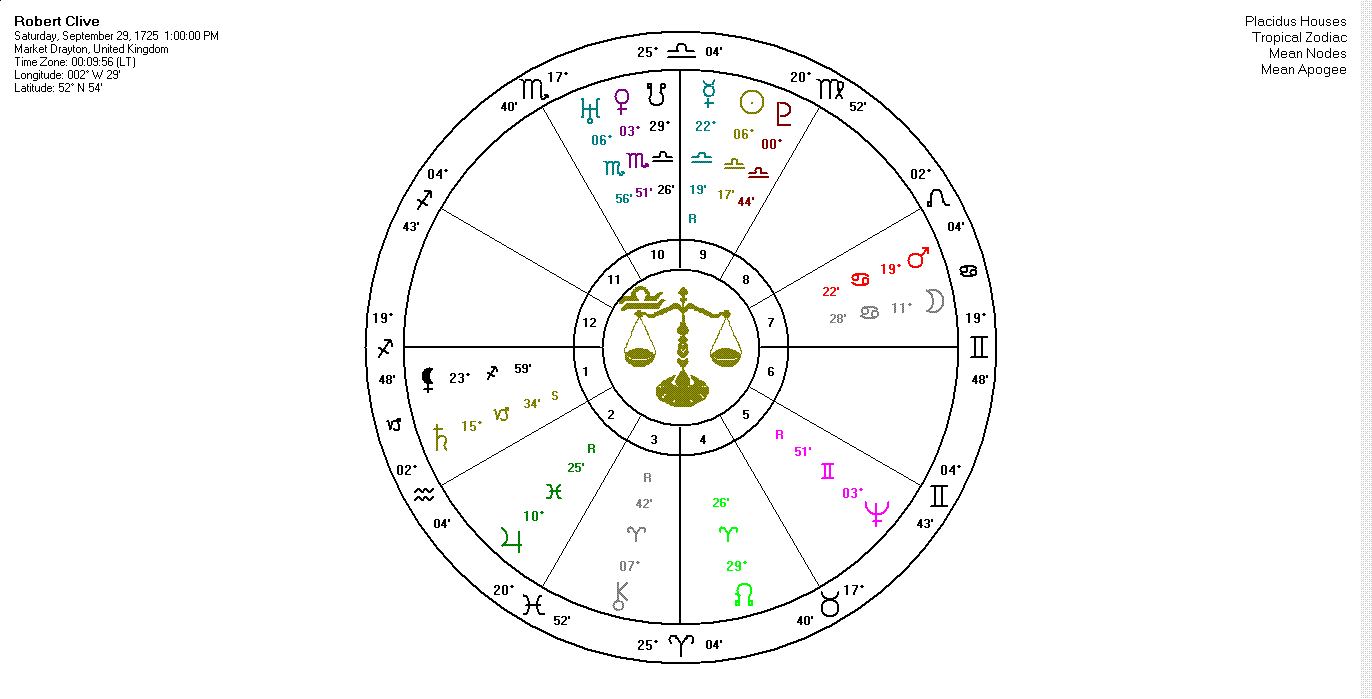
The time of birth is not known. The natal chart is therefore speculative.
Much of Clive’s career seems to have revolved around active military service to subjugate India and the accumulation of wealth for himself and the EIC. His Moon and Mars in Cancer suggests a desire to accumulate wealth. The Libra stellium also supports this supposition. His ability to make a small company grow is shown by the Sun/Pluto conjunction and the two planets in Cancer. Pluto is the planet of growth and regeneration.
Looking at the methods Robert Clive employed to achieve his ends, we find he was not always a paragon of honesty. The wide square from Mercury to Saturn gave a hard nature with a tendency to plot and scheme. The Mercury/Mars square may have encouraged self-importance, fault finding, and irritability. Biographical information on that is wanting.
___________________
Note: The EIC controlled the trade in basic commodities such as cotton, silk, sugar, salt, spices, tea, gemstones, and saltpeter. It was EIC tea that was dumped into Boston Harbor in 1773 by colonists protesting the imposition of taxes.