
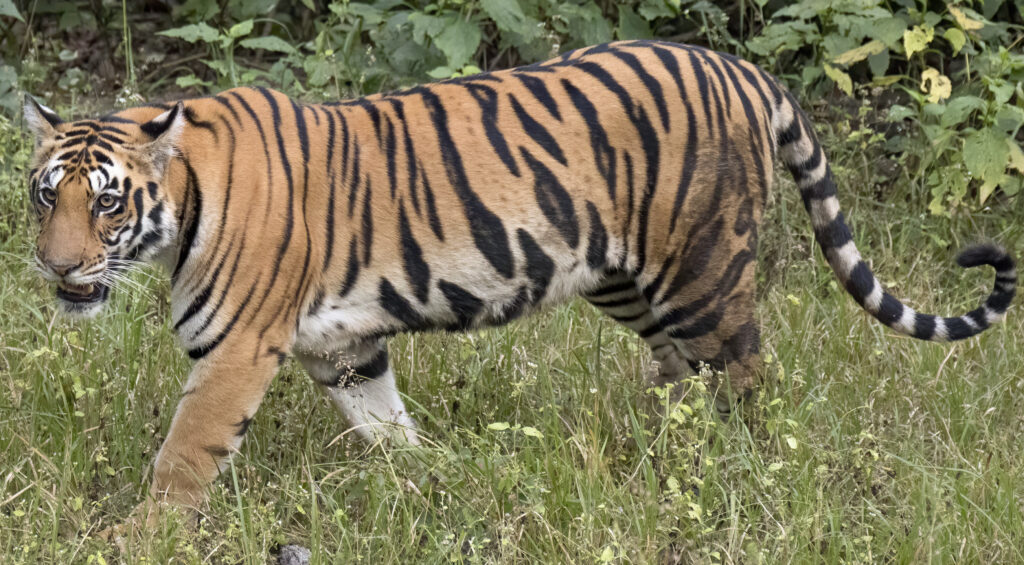
The photograph of a walking tigress was taken by Charles J. Sharp in Kanha National Park in India.
“Tigers, except when wounded or man-eaters, are on the whole very good tempered. Occasionally a tiger will object to too close an approach to its cubs or to a kill it is guarding. The objection invariably takes the form of growling, and if this does not prove effective it is followed by short rushes accompanied by terrifying roars. If these warnings are disregarded, the blame for any injury inflicted rests entirely with the intruder.” (Jim Corbett, goodreads)

“A tiger’s function in the scheme of things is to help maintain balance in nature, and if, on rare occasions when driven by dire necessity, he kills a human being or when his natural food has been ruthlessly exterminated by man, he kills 2 percent of the cattle he is alleged to have killed, it is not fair that for these acts a whole species should be branded as being cruel and blood thirsty.” (Man-eaters of Kumaon by Jim Corbett)*
Note: A tiger becomes a man-eater because it is injured, has broken teeth, is old, or because its natural prey is scarce. Human beings are easy prey as they are slow and do not possess a keen sense of smell or hearing.
The Man-Eater of Chowgarth
On an April evening in 1929, Leo Jim Corbett arrived in the Kala Agar Forest in Kumaon, India. For four years a tiger called the “man-eater of Chowgarh” had terrified the inhabitants there and had killed and eaten sixty-four of them. (The Vintage Gun Journal, “The Chowgarth Man-eater,” Issue 74, August 2025)
Corbett knew the tiger would be hard to track for its kills were spread out over a distance of 1,500 miles, and some attacks were 50 miles apart. Jim was a solitary man who hunted on foot. The search area encompassed a myriad of villages connected by well worn paths that often went into dense forest. (Ibid)
Fast forward to almost a year later. The rainy season has come and gone. Corbett had been misdirected by natives, and the tiger had killed another twenty-six people. Jim tenaciously kept after the elusive predator. Another nineteen days passed by. Suddenly, Corbett came across a kakbar (barking deer) grazing. He approached an outcrop of rocks ahead of him and became uneasy. Tigers always approach prey upwind or lie in wait down wind. The rocks were a perfect ambush spot for the tigress. The kakbar let out a call of alarm and fled. (Ibid)
Keeping downwind as much as possible, Jim went around the rock cropping and then backtracked. He noticed the tiger’s tracks were over his own. She had been waiting for him. The light was fading. The tigress had gone into the underbrush. (Ibid)
The next day he hiked to a spot where a young boy had been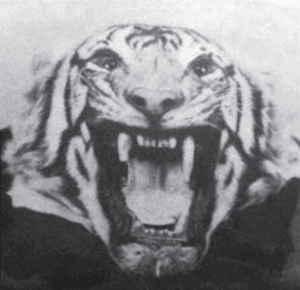 killed a month earlier. He found some bird’s eggs to add to his collection. Sitting atop a rock overlooking a ravine, Corbett jumped down and went around it. Jim was holding the eggs in one hand. There in an enclosed sandy area was the Chowgarth Man-eater. With her hind legs tucked beneath her, she was ready to spring! Corbett swung his rifle around, extended his arm, and fired. The tigress, struck in the heart, died without moving. (Ibid)
Driven to Extinction
*There are about 1,250 tigers left in India. Other animals too are being driven to extinction. Only 500 to 650 Asiatic lions are left in the wild. They are smaller than their African cousins. Snow leopards number 500. With strict and targeted conservation measures, rhinos were saved from dying out. Their population stands at 3,700. The Indian antelope or blackbuck numbers 25,000. It had declined to 8,000. In 1947 there were 80,000. Just 4,000 Lion-tailed Macaques (monkeys) are alive because of habitat loss and hunting (Earth. Org, “Ten of the Most Endangered Species in India” by Olivia Lai, March 4, 2024)
In Africa only 400,00 elephants exist. And the same number of buffalo. 20 to 25,000 lions are with us. There are about 10,000 rhinoceros. (AZ Animals, “The Dark History of Africa’s Big Five and Their Conservation Status” by Lex Basu, January 31, 2025) In the aggregate, wildlife populations have plummeted by 73% in half a century.” (Natural History Museum, Emma Caton, October 11, 2024)
Jim Corbett Horoscope Analysis and Biography
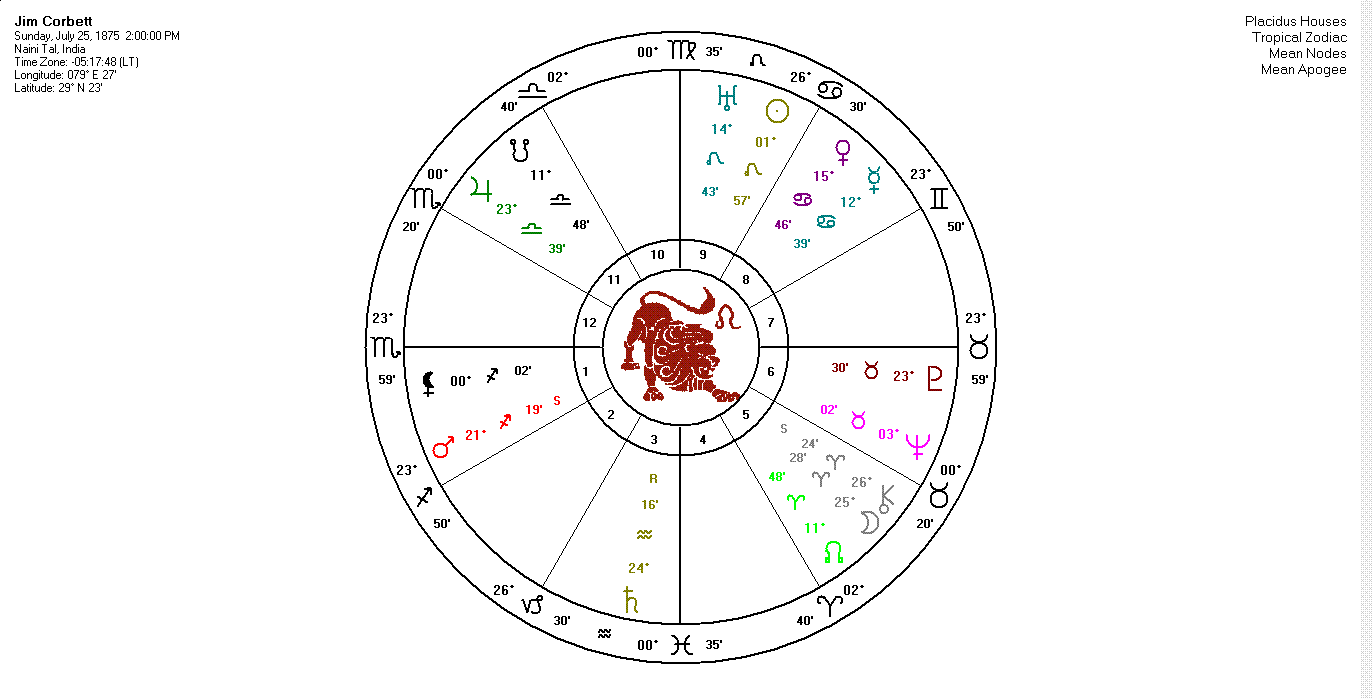
Jim Corbett was a Leo, an apt sign for a lion, tiger, and leopard hunter. He may have had a natural or intuitive feel for and about these carnivores, their natural responses, and instincts.
Corbett’s Moon in Aries would have quickened his reaction time. Conjoined with Chiron, he would have been able to heal his deepest emotional wounds and those of others who had lost kin or friends to the man-eaters.
Corbett was the eighth of nine children. His family was well off the first five years of his life, and he picked up local languages from servants. Jim’s father died in 1881. (Wikipedia, “Jim Corbett”)
Corbett’s older brother taught him to shoot and he began to hunt at the age of eight. After his brother married, he realized he would have to take care of his mother and sisters later in life. He left home at seventeen and became a fuel inspector. (Ibid)
Jim spent many years working for two railway companies. In World War I he formed his own unit which served on the Western Front in bad conditions. Corbett built a brick building for his Indian troops with a drying room and bathroom. It was heated by an incinerator. Jim was promoted to major at the end of the war. In World War II he taught jungle survival to soldiers destined for Burma. (Ibid)
Jim’s Moon in Aries perhaps indicates military service. It is also trine Mars.
Jim’s Mars was well-aspected. It is part of a fan shaped complex with sextiles on both sides. This will strengthen the God of War. No doubt he had courage.
Mars is in Sagittarius, a sign associated with the outdoors. It is trine Chiron. This would have made him restless and hyperactive. (12AndUs: “Mars and Chiron Aspects in the Birth Chart”)
Corbett’s Black Moon Lilith was in adventurous Sagittarius. (Astrology: Black Moon Lilith in Sagittarius Meaning)
In the 1920s Jim invested in coffee and served as vice chairman for the municipal board of Naini Tal. He improved civil engineering and passed laws prohibiting excessive fishing and deforestation. Corbett wrote a number of books in the 1940s about India and hunting with a conservation undertone. (Wikipedia)
Jim Corbett’s path was unique, and the trine of Jupiter to Saturn ensured he was successful.